To mark Artists' Day, we turn to some lesser-known yet remarkable chapters of our cultural heritage. Certain places in Ukraine have produced such an extraordinary concentration of talent that their stories deserve to be known far beyond the country's borders. One of these places is Deliatyn, a small town in the Carpathians.
Deliatyn connects the stories of two outstanding 20th-century artists: Fryderyk Pautsch and Osyp Vaskiv. Both were shaped by the same Carpathian landscape, yet their creative journeys could hardly have been more different. One rose to prominence within Europe's academic art world; the other followed a solitary path as a philosopher and avant-garde artist.
Fryderyk Pautsch – bringing the Hutsul world into European art
For Fryderyk Pautsch (1877-1950), Deliatyn was where everything began. Born in the town, he discovered his earliest fascination with beauty there. Although his education and career would take him from legal studies to art academies in Paris, Vienna and Berlin, the Carpathians remained close to his heart throughout his life.
- An ethnographic breakthrough. Between 1903 and 1904, Pautsch joined fellow artists Władysław Jarocki and Kazimierz Sichulski in organising extensive expeditions to document Hutsul life, traditions and rituals. Their work brought the distinctive culture of the Carpathian highlanders into sharper focus.
- Recognition across Europe. Pautsch's depictions of Hutsul people became a defining feature of his artistic identity. His Hutsul series earned recognition at major European exhibitions, including the Great Berlin Art Exhibition of 1914.
- An accomplished academic career. His work brought him considerable professional recognition. He served as professor of decorative painting in Breslau (now Wrocław) and director of an art school in Poznań, before becoming a professor and eventually rector of the Academy of Fine Arts in Kraków.
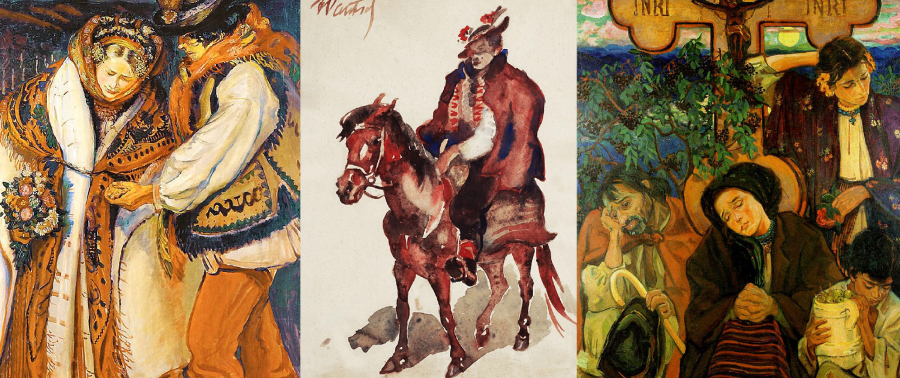
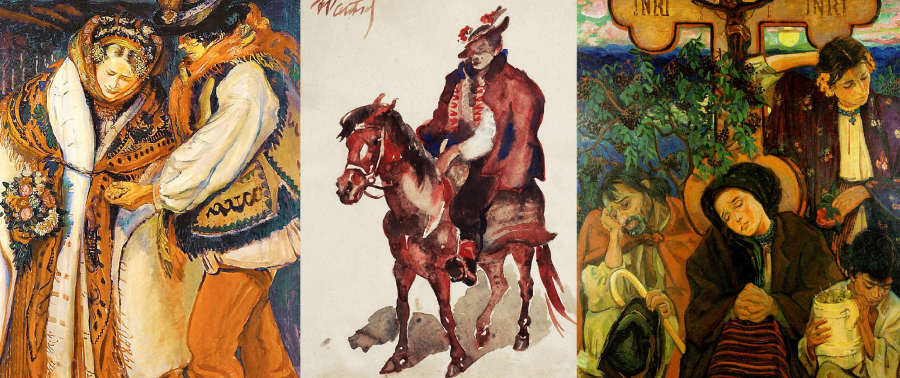
Through his paintings, Pautsch introduced European audiences to the Hutsul region as a rich, vibrant and distinctive cultural world. He transformed scenes from the everyday lives of Ukrainian highlanders into works of European fine art.
Osyp Vaskiv – a solitary explorer of metaphysics and the Ukrainian Paul Klee
While Deliatyn was the starting point of Pautsch's artistic journey, for Osyp Vaskiv (1895-1972) it became a place of refuge, marked by both tranquillity and hardship.
Born in Lesser Poland, Vaskiv was an extraordinary artist and intellectual who taught at a school in Deliatyn until his dismissal in 1949. His biography explicitly attributes his dismissal to his attendance at church, while the official school order cited his failure to provide communist education.
- An independent artistic identity. Vaskiv deliberately kept his distance from political systems and established conventions. Even the way he signed his paintings reflected this independence: he used the name Vaśkóv, following neither Polish nor Ukrainian spelling rules. It was a small but telling expression of his determination to remain true to himself.
- Exploring the avant-garde. His early work developed alongside the radical artistic experiments associated with Kazimir Malevich. In his approach to art and visual thinking, Vaskiv has often been compared to the Swiss painter Paul Klee. Rather than creating paintings simply to decorate spaces, he sought to construct entirely new realities.
- The philosophy of artistic creation. Drawing on the Socratic concept of maieutics, Vaskiv approached the artist's role as that of a "midwife" helping beauty come into being. His task, as he understood it, was to draw images from the apparent emptiness of the metaphysical world. Under Soviet rule, his creative output diminished, but his artistic commitment endured. His work remained an expression of unwavering devotion to art.
The Deliatyn connection
Artists' Day, celebrated on 11 October, offers an opportunity to reflect on the many different paths a life devoted to art can take.
Fryderyk Pautsch and Osyp Vaskiv remind us that genuine artistic expression grows from an exceptional sensitivity to the world and a deep, almost mystical connection to the Carpathian landscape. Rediscovering their stories and preserving their names is part of our responsibility towards the shared history of Ukrainian and European culture.
You can discover works by both artists at the Museum of the History of the Deliatyn Region.
The main banner features paintings by Fryderyk Pautsch: "Wedding Couple", "Hutsul on Horseback" and "Under the Cross".