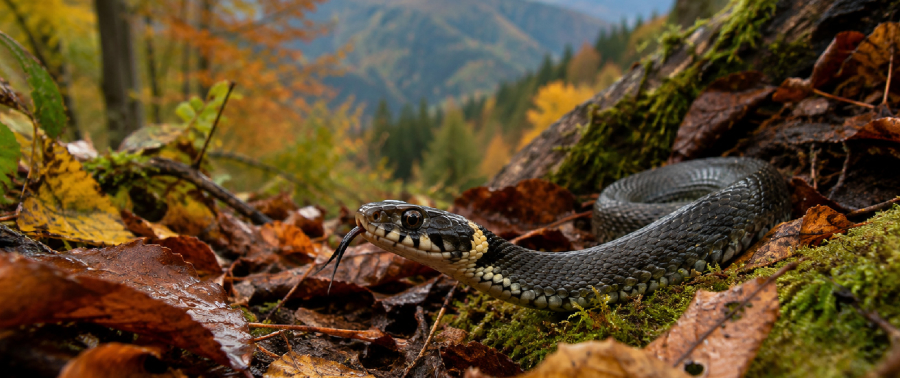
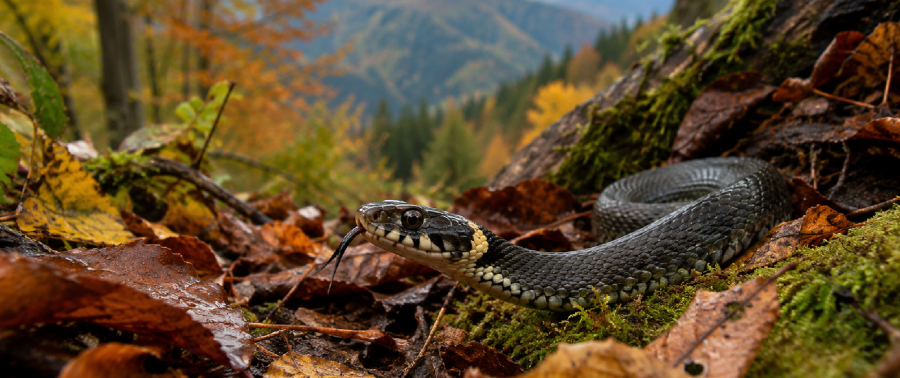
Not long ago, one of our colleagues spotted an unexpected visitor near the Prutets river, which runs through Bukovel resort. Moving effortlessly through the current, an agile little creature was making its way towards the riverbank. It was a grass snake – and the riverside was exactly where you might expect to find one. These reptiles feel right at home in the water: they are excellent swimmers and divers, and rivers and ponds provide much of their food, particularly frogs and fish.
Let's take a closer look at this fascinating Carpathian reptile.
Grass snakes are easy to recognise by the distinctive yellowish or whitish markings behind their heads, which resemble a small collar. Their colouring varies from olive green to almost black, and some can grow up to 1.5 metres long.
Despite the unease that snakes sometimes inspire, the grass snake is non-venomous and generally prefers to keep its distance from people. When threatened, its first instinct is to escape or find somewhere to hide. If it cannot get away, it may hiss, lunge forward with its head, release an unpleasant-smelling secretion or even play dead. These are all defensive behaviours intended to avoid confrontation.
Grass snakes are familiar inhabitants of the Carpathians. They are found throughout Ukraine and are remarkably adaptable, living in a variety of habitats ranging from lowlands to mountain landscapes.
Like every creature that makes its home in the forest or beside a river, the grass snake plays an important part in the local ecosystem. Its diet consists mainly of amphibians and fish, although it occasionally catches other small animals. In turn, grass snakes become prey for birds such as eagles, kites and storks, as well as martens and foxes. With so many natural predators, few survive to old age in the wild, even though their potential lifespan is around 15-25 years.
Grass snakes are active during daylight hours and particularly enjoy basking in the sunshine. They can spend much of the day soaking up its warmth, usually reserving the mornings and evenings for hunting. If you happen to come across one while exploring the resort, give it plenty of space. Don't approach, touch or try to catch it. Instead, leave an escape route open and allow the snake to move away to safety at its own pace.
Snakes may not be everyone's favourite animals, but the grass snake is one of the most harmless species people are likely to encounter. Interestingly, our ancient Slavic ancestors regarded it as a sacred creature. In many rural homes, grass snakes were even welcomed as household companions, with villagers traditionally setting out bowls of milk for them. In return, the snakes helped control mice and rats in barns and outbuildings, making themselves useful in much the same way as domestic cats.
Encounters like this remind us that fascinating wildlife lives not only deep in the forests surrounding Bukovel, but also right here, within the resort itself. The next time nature unexpectedly crosses our path, it's worth stopping for a moment, observing quietly and letting the animal carry on undisturbed.
After all, when you think about it, we're the visitors in these mountains. The true residents are the creatures that inhabit the forests, rivers and meadows. How we treat them today will help determine whether the Carpathians remain a safe home for them tomorrow – and whether Bukovel continues to be the same welcoming little haven of happiness for those who come to enjoy it.