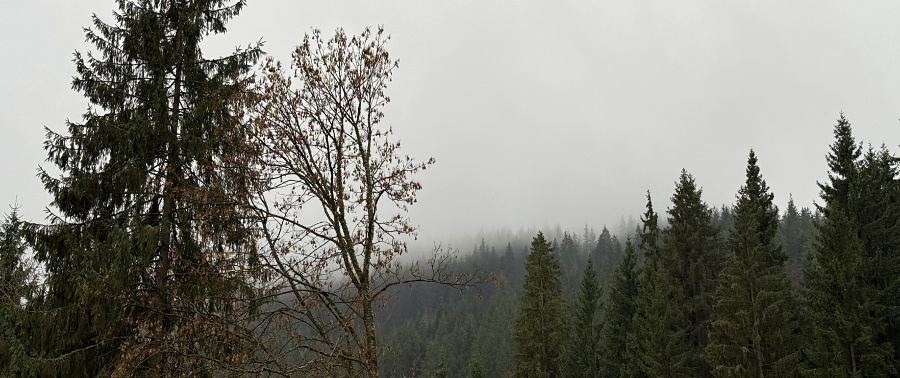
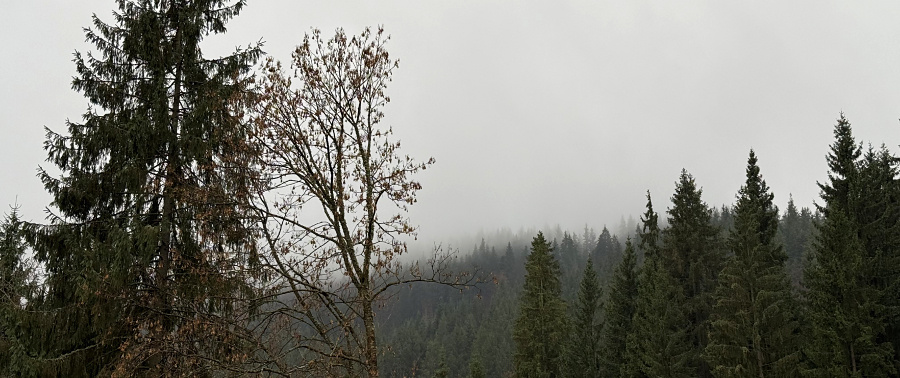
There are moments when you wish you could stop time, just long enough to share something truly breathtaking. For me, the Ukrainian Carpathians have always been that special place, somewhere I can draw strength and inspiration. These mountains are far more than a collection of ridges on a map. They're a vast, living wilderness, where ancient spruce forests climb relentlessly towards the sky before disappearing into distant blue-grey clouds. Rushing rivers tumble through the valleys, while small yet surprisingly deep lakes reflect the heavens in their crystal-clear, icy waters.
Standing high in these mountains, the air feels almost tangible, rich with a sense of renewal. You want to fill your lungs with the resinous fragrance of spruce, fir and pine. The wind carries other scents from the alpine meadows too: the rich, invigorating aromas of wild berries and Carpathian herbs. But perhaps the most captivating sight is the ever-changing movement of the clouds. One moment they race upwards into the open sky; the next they sink heavily onto the shoulders of tired mountain summits. It's in moments like these that you experience an overwhelming sense of freedom.
It was here, among these magnificent, untamed cliffs, with the haunting yet majestic call of the trembita echoing through the mountains, that Oleksa Dovbush was born. He would become the legendary outlaw hero who led the opryshky, the fiercely independent Carpathian rebels whom no one could ever bring to heel.
Following the winding mountain paths, it's easy to imagine that every stone and every highland meadow still remembers his footsteps. Legend tells of a sacred stone called Tserkva-Gorgan, which can still be found on the Rokyta mountain pasture. It was here, according to the story, that Dovbush, then a young shepherd, defeated an evil spirit. As a reward, God appeared to him in the form of a Grey-Haired Old Man and bestowed three magical hairs upon him. Shimmering gold and silver like sunlight and moonbeams, they became protective charms that guarded his life. Every mountain summit seems ready to testify to his bravery and the unquestioned respect he commanded among his companions. The Hutsuls believed so deeply in his sense of justice, quick thinking and remarkable gift for understanding other people's souls that they saw him as the living embodiment of their ancient gods, whether Perun, the thunder god, or the Good Buzh. Centuries of ancestral mythology seemed to come together in this one extraordinary man.
Today, the road towards Bukovel Resort takes us straight through this landscape of legend and rebellion. Every stretch seems steeped in stories of a time when these mountains were a refuge for those who refused to surrender.
Our first encounter is with the quiet village of Yamna, now a neighbourhood of Yaremche. Oleksa's cousin once lived here, and some of his most trusted companions, Pavlo Orfeniuk and the Droniv brothers, also came from the village. Above the rushing waters of the Prut stands a large stone topped with a cross. According to an old local legend, the courageous outlaw leader found his final resting place beneath it. Just a few steps to the left, the mysterious Dovbush Trail leads upwards towards towering cliffs and deep caves, where the opryshky's hidden treasures are said to remain undiscovered. Back in the village, the wooden Church of St John the Merciful stands proudly. Local elders recount how the magnificent iconostasis of fragrant cedarwood in an earlier church was financed with gold coins donated by Dovbush himself. Yamna was a poor village of barely more than forty households at the time and could never have afforded such craftsmanship. The story goes that Oleksa later returned in secret to inspect the finished work with his own eyes...
Continuing onwards, we reach Mykulychyn, once a major crossroads of the opryshky's mountain routes. Historical maps show how Dovbush and his companions travelled through these forests year after year. Their journeys began each spring, when the first cuckoo calls echoed through the mountains near Yasinia, a village in Transcarpathia. The opryshky assembled on Mount Stih before slipping out of sight through the mountain pass between Syniak and Dovbushanka, eventually reaching the Zelenytsia highland pasture near Mykulychyn.
Mykulychyn was also home to an ancient church that once stood on the site of the old cemetery. Dovbush contributed generously to its upkeep and frequently came here himself, bowing his head in heartfelt prayer before the sacred icons. Perhaps that was precisely why his enemies chose this place for their cruelest act. To strike fear into the hearts of the Carpathian people, they displayed the quartered remains of the executed outlaw hero on a stake beside the church. But according to legend, the desecrated sanctuary could not bear such an outrage. Before long, a mighty thunderbolt tore through the darkened sky, setting the church ablaze and carrying its secrets into the past.
The road takes us further into the mountains, and suddenly Mount Khomiak comes into view. Its striking, pyramid-like silhouette tells us that Bukovel Resort is now close. Yet my thoughts wander back to the days when a young Oleksa first discovered the traditions of life on the mountain pastures beneath this very peak, working alongside Ihnat, the leader of the local shepherds. I picture him learning to prepare his first budz cheese and pack freshly made bryndza into a wooden berbenytsia. It was here, too, that he first lifted a trembita to his lips and formed a lifelong, unbreakable bond with these mountains.
Then Mount Syniak emerges on the horizon, joined by a narrow mountain ridge to Malyi Gorgan. Viewed from the air, the two peaks seem to embrace, forming the shape of an enormous Serpent bowing its head towards Dovbushanka. Oleksa and his companions often spent the winter here, and stories tell of a house built from massive beech logs that once stood on the mountain. The local landlords burned it to ashes, determined to erase every trace of the rebellious outlaw. Yet the stone upon which the mountains are said to have cradled Oleksa as a child remains standing to this day.
According to Hutsul belief, that stone conceals a secret entrance to unimaginable riches. Syniak and Malyi Gorgan themselves are said to be the petrified body of a giant Serpent defeated long ago by the Carpathian outlaw hero. Turned to stone, the creature must guard the opryshky's gold for all eternity. No wonder countless treasure hunters, hoping to make an easy fortune, have failed to discover it. The Serpent cannot even lift its head or glance aside, for every so often a small cloud appears above Dovbushanka. That cloud is said to be Oleksa's faithful horse, Thundercloud, watching from the heavens to make sure the guardian never neglects its duty.
But speak to those mountain dwellers who know the oldest and most closely guarded stories, and they'll smile before telling you that Dovbush's greatest treasure was never gold. It is the remarkable protected natural area known as the Dovbushanka Primeval Forest. Here, magnificent fir, spruce and beech trees have stood for more than 180 years. Legend holds that they grew from secret underground cellars where healing fruits were once kept to treat wounded opryshky. And this ancient woodland continues its mission today, offering renewed health, physical strength and profound peace of mind to Hutsuls and travellers alike, anyone eager to experience the extraordinary world of the Carpathians.
The untamed, mythical spirit of these mountains is still alive in every gust of wind, every weathered wall and every stone beside the road. There's something extraordinary about feeling connected to a mystery so much greater than ourselves, and it's a feeling I simply couldn't keep to myself.
Budz (also called buts) is a traditional Carpathian rennet cheese made from cow's, sheep's or goat's milk.
Rennet cheese is a type of cheese made by coagulating milk with a special enzyme, such as pepsin or chymosin, found in rennet – a substance obtained from the fourth stomach compartment of young calves or lambs.
Berbenytsia is a traditional wooden vessel, similar to a small barrel or tub, long used in the Carpathians to store and transport milk, dairy products and sheep's milk cheeses, especially bryndza.
Written by Oleksandra Mecheva