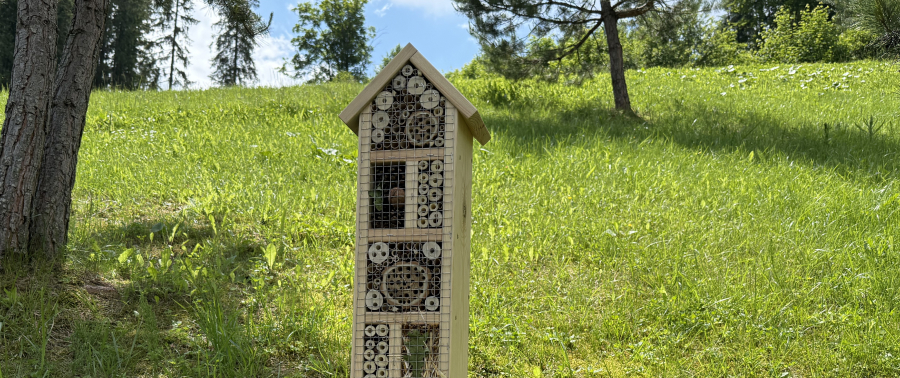
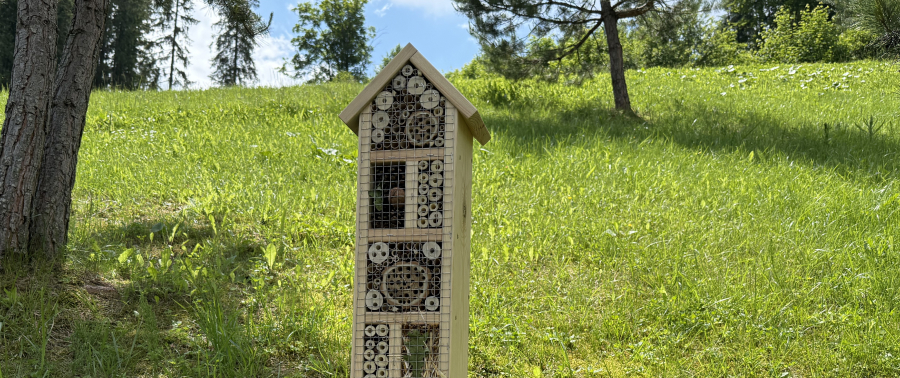
While walking through the resort, you may notice an unusual object near the bridge, set on a green lawn above a small stream. A compact wooden house on a post catches the eye with its distinctive shape and blends naturally into the surrounding landscape.
Yet this is not a decorative installation or a fairy-tale house for forest creatures. It is an insect hotel designed to support biodiversity and provide shelter for important pollinators.
Why insects need our help
Every day, thousands of insects perform work that is essential for life on the planet. They pollinate flowers, help plants form fruit and seeds, and support the natural balance of ecosystems.
Scientists estimate that up to 85% of flowering plants depend on insect activity. At the same time, insect populations are declining rapidly. The reasons include habitat loss, climate change, reduced food sources, pesticide use in agriculture, and the spread of diseases and parasites.
This is why even small conservation initiatives can have real value.
What is an insect hotel?
An insect hotel is a specially designed artificial shelter made from natural materials. It recreates conditions that insects need for living, breeding and overwintering. In a way, it is a small apartment building for some of nature’s tiniest residents. Each “room” can be used by different species:
- wild bees and mason bees;
- butterflies;
- ladybirds;
- beetles;
- other beneficial insects involved in natural processes.
To us, it may look like a compact wooden structure. For its small inhabitants, it is a safe and fully functional home.
What is inside?
Each part of the insect hotel has a clear purpose:
- wooden blocks with holes of different diameters provide shelter for wild bees and mason bees;
- reed and bamboo tubes are used for laying eggs;
- dry branches and bark attract beetles and millipedes;
- cones and straw create suitable conditions for ladybirds and other insects to overwinter.
Such structures are built from natural materials, with openings of different sizes (usually 2 to 8 mm) so that various species can use them. To protect the residents from birds, the front of the hotel is covered with a special wire mesh.
A small house with a big purpose
At first glance, an insect hotel may seem like a charming landscape detail. In reality, it serves an important ecological role: it helps maintain natural balance, increase biodiversity and create a safe space for creatures that quietly support the environment every day.
So next time you pass the small wooden house near the stream, pause for a moment and take a closer look. Perhaps hundreds of tiny residents are already living there – and without them, a healthy Carpathian ecosystem would be impossible to imagine.