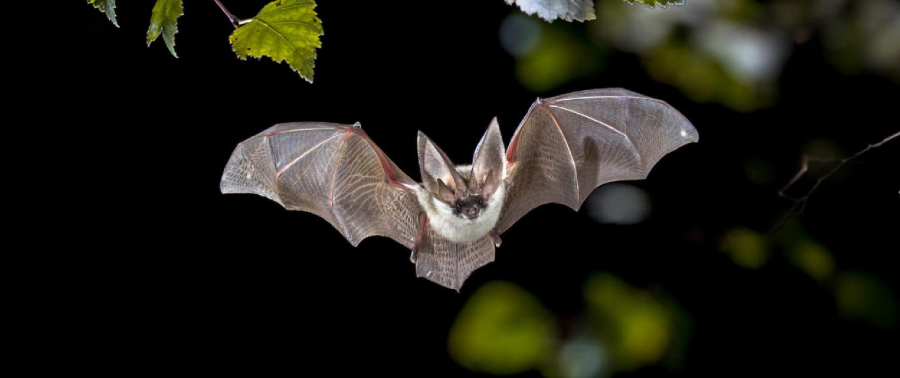

When the last lights in the hotels fade and mountain trails sink into silence, the Carpathians do not truly fall asleep. Between the spruce trees, tiny shadows begin to move across the night sky – almost invisible, almost soundless. These are bats. Among the most mysterious inhabitants of the region, and among the most important.
We rarely notice them. They do not seek attention, make no noise and almost never appear in holiday photographs. Yet every evening they begin their quiet work, helping maintain the natural balance of the mountains.
Night guardians of the forest
More than 20 species of bats live in the Carpathians, and all of them are protected. Their role in nature is far greater than it may seem at first glance. While we sleep, bats hunt mosquitoes, midges and forest pests. In a single night, one small bat can consume hundreds and sometimes even thousands of insects.
This is nature's own form of forest protection. No chemicals. No noise. No intervention. Every night, these tiny creatures carry out work that helps keep the Carpathian ecosystem healthy.
They sense what we cannot
Bats do not rely on sight to navigate in the dark. Instead, they "see" through sound. Their echolocation system is one of the most remarkable navigation tools found in nature.
By emitting ultrasonic signals and analysing the returning echoes in fractions of a second, bats can detect trees, rocks and even the smallest insects in the air. They do this in complete darkness, at high speed and among dense mountain forests.
What may appear to us as an erratic flight is, in fact, a remarkable display of natural precision.
Creatures misunderstood for centuries
For generations, bats have been surrounded by myths and fears, being often associated with danger and mystery. In reality, the truth is far more fascinating.
Bats do not attack people. They do not become tangled in hair and actively avoid contact with humans. They are cautious and vulnerable animals, and humans pose a far greater threat to them than they do to us.
Their world is one of quiet caves, old trees, the night sky and the delicate balance of nature.
Why the Carpathians need bats
Bats are much more than just another part of the region's wildlife. They are indicators of healthy ecosystems.
Where bats thrive:
- old forests remain preserved;
- natural balance is less disturbed;
- the environment stays clean;
- ecosystems remain vibrant and resilient.
Yet their sensitivity also makes them among the first species affected by human activity:
- the loss of old trees;
- excessive lighting;
- the destruction of caves;
- industrial noise.
Sometimes, simply disturbing a winter shelter can prevent a bat from surviving until spring.
Tiny animals with an enormous role
Bats sleep upside down because this position allows them to take flight instantly when danger appears. Their wings are formed by thin membranes stretched across elongated fingers, which explains their scientific name, Chiroptera – meaning "hand-wing".
Some species can live for decades and return to the same places year after year. Despite their modest size, they perform an invaluable role in supporting the natural world.
Protecting what often goes unnoticed
We love the Carpathians for their misty mornings, mountain rivers, the scent of pine forests and the beauty of distant peaks. But the true strength of these mountains lies in the hidden life that quietly sustains this balance every day – in the creatures we rarely notice.
Protecting bats means protecting much more than a single group of animals. It means respecting the natural systems that continue working even while we sleep.
And perhaps the next time a dark silhouette glides across the sky, there will be no reason for fear.
Because bats are another heartbeat of the Carpathians, quietly keeping the mountains alive through the stillness of the night.