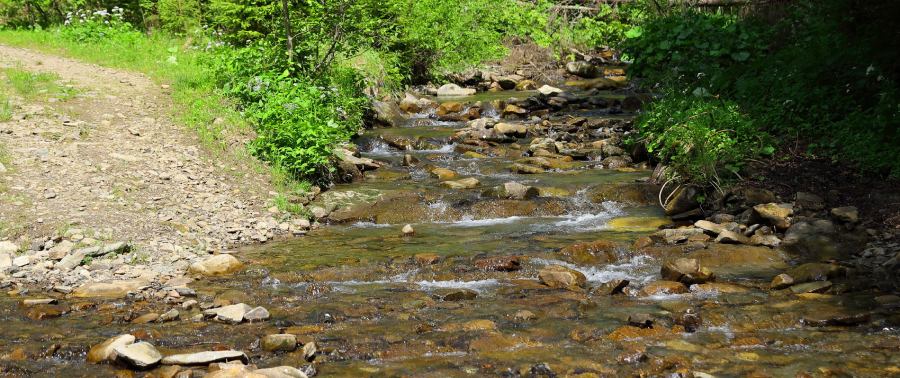
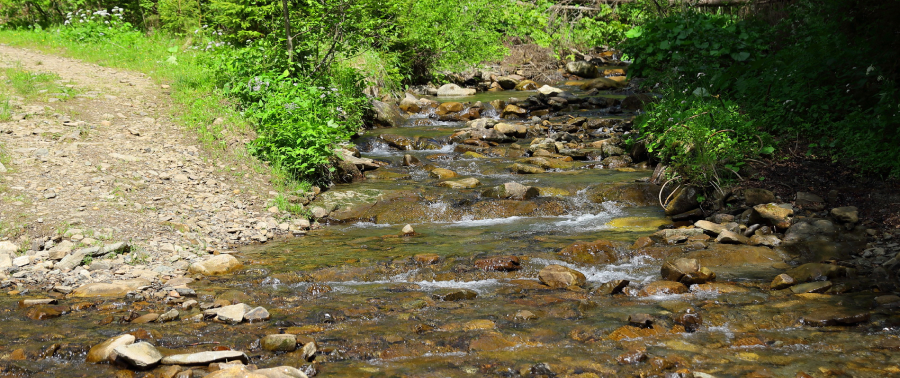
The Prutets Yablunytskyi is a small mountain river that winds through the resort, forming a left tributary of the Prut river. It originates in the mountainous part of the Ukrainian Carpathians, near Yablunytsia Pass, and is approximately 16 kilometres long. Local people affectionately call it Prutchyk.
It may seem that such a small river simply flows between the stones. But if you stop beside it for even a few minutes, listen and look closely, you begin to understand: the Prutets is a living world.
On a sunny day, the river gently murmurs between the stones. After rain, it becomes louder and faster. In winter, it hides beneath the ice, and in spring, it comes back to life along with the mountain forest. Its water is cold and flowing, its riverbed is rocky, and its banks are covered with mosses, grasses, shrubs and trees.
Numerous insects, larvae, spiders, molluscs and other invertebrates live in the waters and along the banks. For some creatures, they are food; for others, they form part of their habitat. For the entire ecosystem, they are an essential part of the natural balance.
In the forests and damp areas surrounding the river, you may encounter much larger inhabitants, such as the Carpathian newt. During the breeding season, it is particularly closely connected with water. Newts seek out small bodies of water and quieter areas near the river where they lay their eggs. Once the breeding season ends, they may leave the water and shelter in damp moss, beneath stones, fallen leaves and fallen trees along the river valley.
The Carpathian newt is a very inconspicuous inhabitant. This species is listed in the Red Data Book of Ukraine. That is why we ask resort guests to be particularly careful when walking near the river. These animals are so small, they can easily go unnoticed and be accidentally stepped on.
Another inhabitant that is particularly easy to encounter after rain is the fire salamander. Its relationship with the river is special. The salamander does not live permanently in water, but its life is closely connected with clean mountain streams, springs and damp riverbanks. In the Carpathians, female salamanders enter the water to give birth to larvae. Young salamanders initially develop in an aquatic environment before moving onto land, where they spend most of their time in damp forests close to water. That is why not only the clean water of the Prutets, but also everything surrounding it – mosses, stones, leaves, trees and moist soil – is so important for salamanders.
If you look carefully at small, quiet pools, damp depressions and areas of slower-moving water near the river, you may spot a yellow-bellied toad. These places are particularly important to the species during the breeding season. It spends a considerable part of its life here, hiding among aquatic vegetation and searching for small prey. At first glance, it is a small, unremarkable amphibian. But when it senses danger, it displays the bright yellow colouring on the underside of its body, as if to say, "Don't be so quick to touch me."
Now, the next time you walk along the Prutets, try something else. Look at the stones in the middle of the stream. This is where you may see one of the most fascinating birds of mountain rivers – the white-throated dipper. This small bird is remarkably well adapted to life beside fast-flowing water. The dipper can literally "walk" over stones underwater while searching for food. It feeds on aquatic insects and small crustaceans, which it finds in shallow water, between stones and even beneath the surface.
Spotting a dipper is a real stroke of luck. But watching one is even more fascinating: seeing how this little bird boldly enters the cold mountain water, seemingly unaware of the strength of the current.
Recently, during a walk beside the river, we were lucky enough to encounter another small bird. It hopped lightly from stone to stone, as though hurrying somewhere on its own bird-related business. It was a grey wagtail – a slender bird with a long tail and yellow underparts. For this bird, the Prutets is a real dining area. Here it finds small insects, midges and larvae. The grey wagtail is easy to recognise by its movements. It constantly hops and runs from one stone to another, endlessly bobbing its long tail. This makes it seem as though the bird is always "dancing" beside the water.
The Prutets also has inhabitants that are much easier to spot. These are the ducks we have told you about before. Their family can be encountered along many sections of the river. For them, the river has become a true home – somewhere to find food, seek shelter, raise their young and simply live. Over time, they have become familiar local inhabitants of the Prutets, recognised by many resort guests.
The Prutets Yablunytskyi continues to flow along its course, supporting the complex and extraordinarily valuable natural world of the Carpathians.
Author: Iryna Furdela